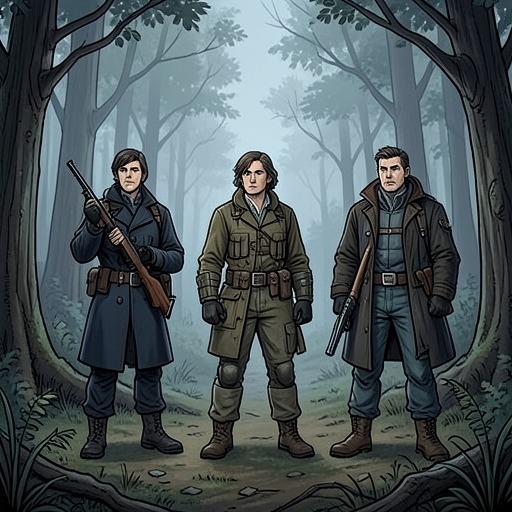
Lionel follows Tony and the Giant to Maine
Motherless BrooklynLionel follows Tony and the Giant to Maine is a road pursuit that carries Lionel Essrog from the tightly watched streets of Brooklyn to the exposed coast of Maine. What begins as a stakeout outside L&L becomes a three-car chain: Tony Vermonte leads, Giant Killer follows, and Lionel shadows them both. Along the way, the chase reveals how Lionel turns scraps of observation into a working theory, while the journey’s final landscape strips away the familiar urban structures that have helped him make sense of himself.
Background and the stakeout
Lionel’s pursuit grows out of the world Frank Minna built around him. As a boy at St. Vincent’s Home for Boys, Lionel lived in the library and tried to read every book there, an effort he connects with fear, boredom, and his compulsions to count and inspect. Minna later recruited Lionel, Tony, Gilbert Coney, and Danny Fantl as the junior staff of L&L Movers, paying each boy twenty dollars and handing out cards that called the business a moving company. The work ranged from ordinary furniture moves to suspicious jobs, and Minna taught the boys to watch clients, gather information, and keep quiet about what they saw.
That training shaped the group’s later life at L&L, but it did not make them immune to loss. In the office, Minna’s absence is registered through its objects: his handwriting in the telephone log, his bite marks on a sandwich, and his cigarette butts in the ashtray. Against that background, Lionel’s investigation is not simply a professional assignment. He is trying to follow the evidence left by Minna and to keep moving through the grief that has filled the office.
The immediate scene begins while Lionel watches L&L. Danny leaves in a Cadillac with Welcome, one of the young bartenders the men sometimes drove home. Tony stays behind and searches the drawers, hurriedly spreading papers across the counter before moving on to a notebook containing Lionel’s own stakeout notes. Lionel reads the episode as a sign that Tony does not trust Danny with everything. His attention then shifts to a hulking figure in a small, bright red car parked nearby: Giant Killer is watching the storefront too. The two watchers now have overlapping targets, and Lionel understands that the advantage he values depends on seeing without being seen.
From Brooklyn onto the highway
Tony eventually comes out of L&L and drives away in the Pontiac. Giant Killer follows in the red compact; Lionel, who has been keeping watch through the night, gets into the Tracer and joins the pursuit. The morning has advanced while he was in a comalike sleep: bakery trucks are rolling, traffic fills Bergen Street, and it is twenty minutes to seven by Minna’s watch. Lionel keeps a safe distance and follows the red car when he loses sight of Tony.
The route first suggests Greenpoint, near the place where Minna met his end, but the cars pass that exit and continue north. Lionel follows them onto the Brooklyn-Queens Expressway, through Queens, past the airport turnoffs, and toward the Whitestone Bridge. His theories keep changing with the road. He wonders whether someone from Fujisaki is arriving at the Japan Air Lines terminal, then abandons that idea when the red car takes the ramp toward the bridge. Four sandwiches and a six-pack in Tony’s car become a practical clue: the group is going out of town. Lionel has brought a matching supply of food, an improvised readiness that turns the pursuit into a long-distance undertaking rather than a brief tail through the city.
Beyond the Whitestone, the chase proceeds through Connecticut. Lionel follows Giant Killer’s red car along the Hutchinson River Parkway and the Merritt Parkway, keeping far enough back to avoid drawing attention. Traffic thickens around Hartford, briefly bringing the cars close together. Lionel notices the peculiar correspondence between his own Tracer and the Giant Killer’s Contour, as if one car were a drawn line tracing the other’s path. The highway’s steady demands—accelerating, checking mirrors and blind spots, turning his neck—absorb Lionel’s tics and help keep him awake despite his exhaustion.
Reading the pursuit
At a rest area, Tony slows and pulls in, but Giant Killer continues past. Lionel takes that difference in movement as decisive: Giant Killer already knows where Tony is going and expects to arrive first. The pursuer has stopped needing to follow the immediate route because he has identified its destination. Lionel recognizes the same structure in his own position. He has been following Giant Killer as Giant Killer follows Tony, each man trying to gain an edge over the person ahead.
The shift turns observation into a contest of inference. Lionel buys a map of New England and uses the brochure for A Place of Peace to work out the route. The roads point through Massachusetts, across a corner of coastal New Hampshire, and toward the Maine Turnpike; the brochure’s rudimentary map identifies Musconguspoint Station as the coastal village connected with the destination. Lionel now has a reason to try to get ahead rather than merely remain behind the red car. His advantage is thin, however: he is relying on Giant Killer’s confidence that he cannot himself be followed, even as Lionel has been relying on the same confidence in his own concealment.
The pursuit also brings the investigation’s paper trail into view beyond the cars. Earlier, a rental-car registration card and receipt had linked a vehicle to the Fujisaki Corporation at 1030 Park Avenue, and Lionel had asked Loomis to investigate the building and its management. Later, Gerard Minna explains the financial arrangement behind the building: his students supplied maintenance and service work as part of their training, while Frank and Ullman diverted much of the multimillion-dollar contract’s difference into their own pockets. That explanation clarifies the larger stakes surrounding Fujisaki and Minna’s death, though the road chase itself proceeds by immediate clues—cars, food, maps, and the Giant Killer’s change of pace.
The coast and its edge
When Lionel reaches the restaurant in Maine, Yoshii’s, he parks above the water near the fishing dock and ferry landing. The lunch service has not yet begun, and he sees no sign of Tony or Giant Killer. Instead of waiting in the open parking lot, he climbs down toward the water, passing out of sight of the road and buildings. The move is practical, but the terrain changes the meaning of his search. In Brooklyn, streets, storefronts, offices, and familiar neighborhoods have given him a dense framework for reading people and events. At the coast, he experiences the landscape as a loss of that framework: the sky and ocean leave him without the word-filled walls he has depended on.
The episode’s final reversal is therefore inward rather than a resolution of the pursuit. Lionel has crossed a long distance by converting details into a route, yet the destination confronts him with an expanse that resists his usual verbal and urban coordinates. He staggers and steadies himself on the rocks; then he shouts into the surf, but the cry is lost. The chase has brought him to the place he sought, while also exposing how precarious his sense of orientation becomes when the streets and language that have sustained it fall away.